DigiRosary

A quieter way to pray

Pray the Rosary,
one bead at a time.

DigiRosary is a quiet, tactile prayer companion with guided mysteries, a virtual bead chain, and paced reading designed to keep the prayer—not the screen—at the center.
  • 121selectable prayer editions
  • 120non-English Beta editions
  • 113localized interfaces
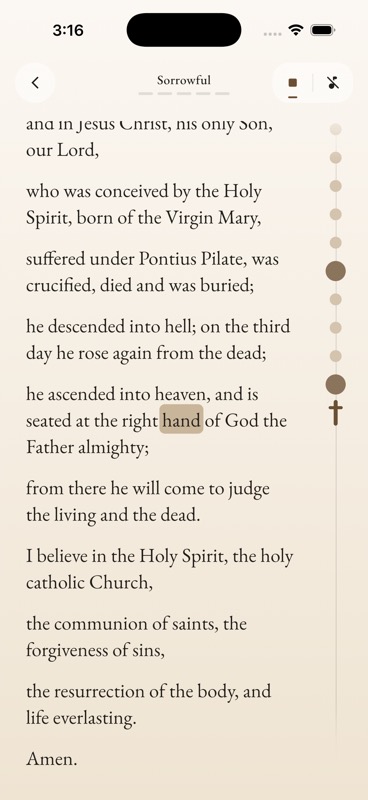
Actual DigiRosary prayer screen with compact auto-read and ambient music shortcuts, active word highlighting, prayer progress, and a vertical Rosary bead rail on the right
Actual interface from the current app build

The prayer stays central

A guided rhythm,
not a crowded screen.

Move naturally through the complete Rosary—from the opening prayers to the final Sign of the Cross. The screen gives you only what you need for the moment, then gets out of the way.

  • Drag the vertical beads to move through the prayer.
  • Read with phrase focus, or tap the compact auto-read shortcut to start or stop paced highlighting.
  • Resume a mystery exactly where you paused.

Thoughtful in every detail

Made for the way you pray.

Familiar enough to begin immediately, flexible enough to become your own prayer book.

Guided from beginning to end

Opening prayers, five decades, mystery reflections, and closing prayers—with all four mystery sets and a suggestion for the day.

A Rosary you can feel

Choose left- or right-hand bead placement, four bead styles, gentle haptics, and subtle sounds.

Reading at your pace

Set prayer text and auto-read speed in Settings; auto-read highlights prayers, mystery headings, and Scripture word by word.

Pray in your language

Choose from 121 prayer editions, including distinct Mandarin and Cantonese experiences and right-to-left editions such as Arabic.

English is stable; all 120 non-English prayer editions are Beta. Of those, 112 also localize the app interface, making 113 localized interfaces in total. Aramaic, Chiquitano, Kichwa (Highland), Ge’ez, K’iche’, Kikuyu, Port Sandwich (Lamap), and Nahuatl currently use English controls pending qualified translation.

Make the prayer yours

Create custom prayer versions, edit mystery text, include optional prayers, and place local prayers in the sequence—or on a particular bead.

A practice you can return to

Set local reminders and view streaks, daily counts, 12-week activity, yearly progress, and per-mystery totals.

Begin with stillness

Optional four-count box breathing uses the same particle visualization as the app, with ambient sound and tactile cues when you choose them.

Breathe in

One prayer, many languages

Choose the words that feel like home.

Every bundled prayer edition is selectable: English plus 120 non-English Beta editions. The app offers 113 localized interfaces in total: English plus 112 non-English Beta interfaces. Eight prayer-only editions—Aramaic, Chiquitano, Kichwa (Highland), Ge’ez, K’iche’, Kikuyu, Port Sandwich (Lamap), and Nahuatl—currently use English controls pending qualified translation.

  • English
  • Spanish ( Español ) Beta
  • Português ( Portuguese ) Beta
  • Filipino ( Tagalog ) Beta
  • Italian ( Italiano ) Beta
  • Français Beta
  • Polish ( Polski ) Beta
  • German ( Deutsch ) Beta
  • Cebuano ( Bisaya ) Beta
  • Hiligaynon ( Ilonggo ) Beta
  • Ilocano ( Iloko ) Beta
  • Latin ( Latina ) Beta
  • Vietnamese ( Tiếng Việt ) Beta
  • Chinese (Mandarin) / 中文 Beta
  • Chinese (Cantonese) / 粵語 Beta
  • Indonesian ( Bahasa Indonesia ) Beta
  • Malay ( Bahasa Melayu ) Beta
  • Arabic ( العربية ) Beta
  • Korean ( 한국어 ) Beta
  • Japanese ( 日本語 ) Beta
  • Hindi ( हिंदी ) Beta
  • Tamil ( தமிழ் ) Beta
  • Malayalam ( മലയാളം ) Beta
  • Telugu ( తెలుగు ) Beta
  • Kannada ( ಕನ್ನಡ ) Beta
  • Marathi ( मराठी ) Beta
  • Bengali ( বাংলা ) Beta
  • Gujarati ( ગુજરાતી ) Beta
  • Punjabi ( ਪੰਜਾਬੀ ) Beta
  • Odia ( ଓଡ଼ିଆ ) Beta
  • Assamese ( অসমীয়া ) Beta
  • Konkani ( Romi ) Beta
  • Ukrainian ( Українська ) Beta
  • Croatian ( Hrvatski ) Beta
  • Hungarian ( Magyar ) Beta
  • Czech ( Čeština ) Beta
  • Slovak ( Slovenčina ) Beta
  • Slovenian ( Slovenščina ) Beta
  • Romanian ( Română ) Beta
  • Dutch ( Nederlands ) Beta
  • Russian ( Русский ) Beta
  • Belarusian ( Беларуская ) Beta
  • Serbian ( Српски ) Beta
  • Bulgarian ( Български ) Beta
  • Greek ( Ελληνικά ) Beta
  • Swahili ( Kiswahili ) Beta
  • Igbo ( Asụsụ Igbo ) Beta
  • Yoruba ( Yorùbá ) Beta
  • Hausa ( Hausa ) Beta
  • Amharic ( አማርኛ ) Beta
  • Tigrinya ( ትግርኛ ) Beta
  • Zulu ( isiZulu ) Beta
  • Xhosa ( isiXhosa ) Beta
  • Shona ( chiShona ) Beta
  • Sesotho ( Sesotho ) Beta
  • Dinka ( Thuɔŋjäŋ ) Beta
  • Luo ( Dholuo ) Beta
  • Javanese ( Basa Jawa ) Beta
  • Thai ( ไทย ) Beta
  • ພາສາລາວ ( Lao ) Beta
  • Khmer ( ខ្មែរ ) Beta
  • Samoan ( Gagana Samoa ) Beta
  • Tongan ( Lea Fakatonga ) Beta
  • Māori ( Te Reo Māori ) Beta
  • Hawaiian ( ʻŌlelo Hawaiʻi ) Beta
  • Catalan ( Català ) Beta
  • Maltese ( Malti ) Beta
  • Albanian ( Shqip ) Beta
  • Lithuanian ( Lietuvių ) Beta
  • Latvian ( Latviešu ) Beta
  • Irish ( Gaeilge ) Beta
  • Welsh ( Cymraeg ) Beta
  • Breton ( Brezhoneg ) Beta
  • Basque ( Euskara ) Beta
  • Danish ( Dansk ) Beta
  • Swedish ( Svenska ) Beta
  • Norwegian ( Norsk ) Beta
  • Icelandic ( Íslenska ) Beta
  • Finnish ( Suomi ) Beta
  • Estonian ( Eesti ) Beta
  • Aramaic ( ܐܪܡܝܐ ) Beta
  • Hebrew ( עברית ) Beta
  • Chiquitano ( Bésɨro ) Beta
  • Port Sandwich ( Lamap ) Beta
  • Guaraní Beta
  • Runa Simi ( Quechua ) Beta
  • Aymara Beta
  • Lingála Beta
  • Ikinyarwanda Beta
  • Ikirundi Beta
  • Luganda ( Oluganda ) Beta
  • Chichewa Beta
  • Kikongo Beta
  • Malagasy Beta
  • Tetun Beta
  • Tok Pisin Beta
  • Galician ( Galego ) Beta
  • ግዕዝ ( Ge’ez ) Beta
  • Maithili ( मैथिली ) Beta
  • Luxembourgish ( Lëtzebuergesch ) Beta
  • Armenian ( Հայերեն ) Beta
  • Georgian ( ქართული ) Beta
  • Chaldean Neo-Aramaic ( ܣܘܪܝܬ ) Beta
  • Akan/Twi ( Akan ) Beta
  • Bhojpuri ( भोजपुरी ) Beta
  • Chamorro Beta
  • Ewe ( Eʋe ) Beta
  • Fon ( Fɔngbe ) Beta
  • Kreyòl Ayisyen Beta
  • Kapampangan Beta
  • K’iche’ Beta
  • Kichwa ( Highland ) Beta
  • Kikuyu ( Gĩkũyũ ) Beta
  • Nahuatl Beta
  • Pangasinan Beta
  • Papiamento Beta
  • Santali ( ᱥᱟᱱᱛᱟᱲᱤ ) Beta
  • Sinhala ( සිංහල ) Beta
  • Tshiluba ( Tshiluba ) Beta
  • Urdu ( اردو ) Beta
  • Waray-Waray Beta

“Beta” keeps the quality state visible while non-English prayer text, wording, line breaks, and screen-reader labels continue to be reviewed with native readers.

Your prayer, your choice

Private by default.
Cloud only when you choose.

DigiRosary works without an account. Settings, custom prayers, saved progress, reminders, and practice statistics are stored on your device by default.

Optional pseudonymous usage sharing starts off. During onboarding, DigiRosary asks before creating any analytics identifier or sending any usage event; declining does not limit the app, and the choice remains available in Settings. If you choose to share, the pseudonymous—not anonymous—stream helps estimate how many opted-in readers are actively praying, understand recitation flow, and improve accessibility and the general prayer experience. Online counts include only readers who chose to share, not everyone using DigiRosary. Google Play’s aggregated store and app-health reports are separate. Cloud sync is optional, and bug reports are sent only after you review and submit them.

Made to read comfortably

A prayer companion that adapts.

Adjustable prayer text, system text scaling, localized screen-reader labels, portrait and landscape layouts, and right-to-left Arabic help DigiRosary meet you where you are.

Tap a theme to preview the page in the app’s exact palette.

Warm theme selected
DigiRosary app icon

Android · Closed testing

Help shape DigiRosary 1.0.

DigiRosary is preparing for a limited Google Play test. If you would like to pray with the launch build and share thoughtful feedback, request a tester invite.